

How to Pick a Motion Sensor Night Light for Stairs
Last Updated: November 4, 2026
Quick Summary
To pick a motion sensor night light for stairs, check that each fixture puts out at least 100 lumens with warm white light, space fixtures 24 to 36 inches apart, and choose a power source that matches your outlets. Pick a rechargeable or plug-in model where power is nearby, and a battery model where it is not.
- Confirm each fixture is rated at least 100 lumens for adequate stairway illumination.
- Choose warm white light for a softer glow that is gentler on the eyes at night.
- Space fixtures 24 to 36 inches apart so every tread gets consistent coverage.
- Use plug-in or rechargeable models where an outlet is nearby, and battery models where none is.
- Adjust sensitivity and aim the sensor across the treads to reduce false triggers from pets.
Table of Contents
- Why Stair Lighting Needs Its Own Standard
- Set Your Brightness Target: Lumens and Color Temperature
- Match Sensor Range and Placement to Your Staircase
- Choosing Between Wireless and Hardwired Installation
- Rechargeable vs. Battery-Operated: Which Power Option Fits
- Pet Sensitivity, Glare and Aesthetics
- Your Next Step: Compare Options and Shop Blue Point
- Frequently Asked Questions
Stairs are one of the most common places for nighttime falls at home, and a motion sensor night light is one of the simplest fixes. Choosing the right one takes more than picking the cheapest option online. This guide walks through the decisions that matter most: brightness, sensor coverage, power source and installation.
Why Stair Lighting Needs Its Own Standard
Stairway lighting is a safety question first and a decor question second. A night light that works well in a hallway may fail on a staircase, where a person is moving up or down, carrying items, and needs to see each tread clearly. Consumer Reports tested 17 motion-sensor light models in a laboratory setting to establish performance benchmarks, and the results give shoppers a reliable starting point Consumer Reports laboratory testing of 17 indoor motion-sensing light models.
The core job of a stair light is to reduce tripping hazards during nighttime trips. Motion-sensing lights are widely recommended for exactly this use, because they switch on as someone approaches and do not require a bright overhead fixture. Treat the criteria below as a checklist: brightness, coverage, power, installation, and then the finishing choices.
Set Your Brightness Target: Lumens and Color Temperature
Brightness is the first number to check. A common recommendation is at least 100 lumens per fixture for adequate stairway illumination, according to lighting guidance from PacLights PacLights stairway lighting guidance on lumens per fixture. That figure is a minimum for visibility, not a target for a bright room, so a fixture rated well above it is not automatically better.
Color temperature changes how the light feels as well as how well it works. Warm white light is preferred for nighttime use because it is gentler on the eyes. Cooler light at 4000K and above can feel clinical and harsh in a home setting, which is why many buyers choose warm white for stairways.
Use these two checks before you buy:
- Confirm the rated output is at least 100 lumens per fixture.
- Choose warm white for a softer nighttime glow.
Match Sensor Range and Placement to Your Staircase
Coverage depends on spacing as much as on the sensor itself. Installation guidance for indoor stair lights generally recommends placing lights 24 to 36 inches apart so that each tread receives consistent coverage, according to FlyAchilles FlyAchilles installation guidance for indoor stair lighting. Measure your staircase length before buying, then divide by that spacing to estimate how many fixtures you need.
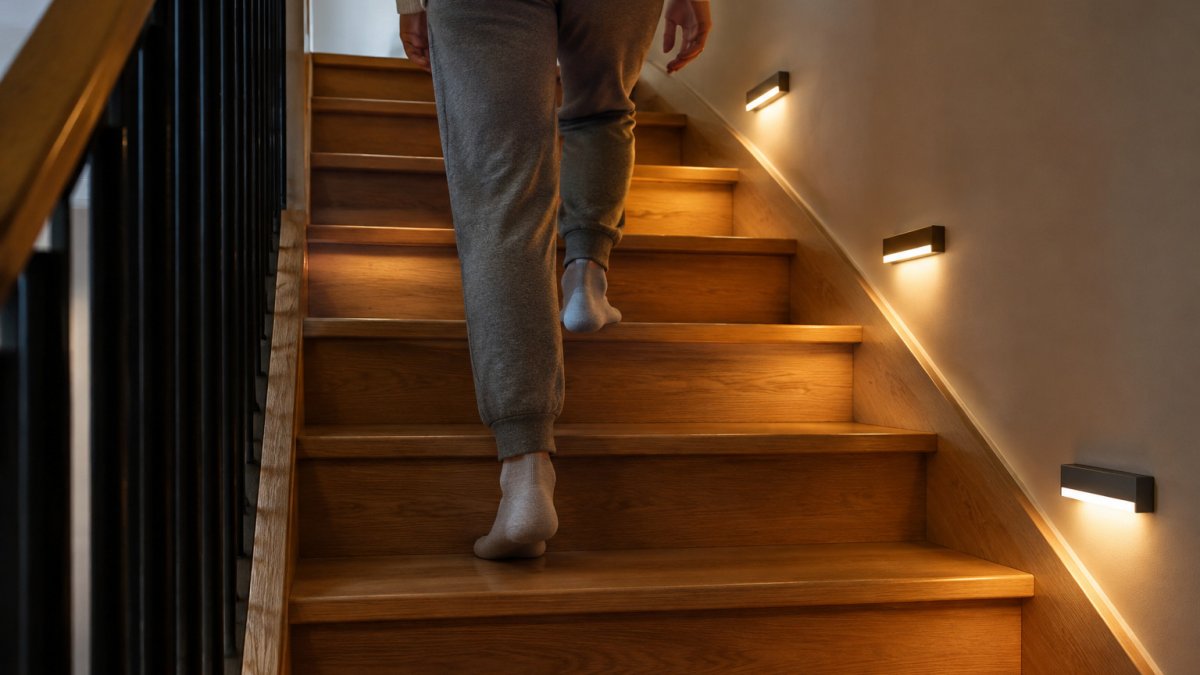
Sensor range also varies by model, so read the detection specifications on the packaging rather than assuming a single fixture covers the whole stair. Mounting at the riser, the vertical face of each step, gives the most even light across the treads.
!A homeowner in socks walking up a lit wooden staircase at night, with small wall-mounted light strips glowing softly along the risers
A single fixture may not cover every step on a long staircase.
Choosing Between Wireless and Hardwired Installation
The useful question is which option fits your staircase's existing electrical infrastructure, your skill level, and your tolerance for future maintenance. Work through the matrix below before you buy anything.
Step 1: Inventory what you already have at the stairs. Walk the staircase at night with a flashlight and note three things: (a) whether any wall outlet, switched circuit, or existing fixture is within reach of the steps, (b) whether the wall or ceiling above the stairs has a junction box you can tap, and (c) whether the stairwell shares a circuit with a room where you can safely add a fixture. If you find a live junction box or an existing switched fixture, hardwired becomes viable. If the nearest power is a hallway outlet two rooms away, wireless is the realistic path.
Step 2: Match the option to your technical comfort level. Hardwired stair lighting typically means running cable through finished walls, cutting in a box, and tying into a circuit. Check local requirements for licensed electrician work and permits before starting. Wireless models use adhesive or screw-mount brackets and battery or rechargeable power, so there is no wiring, no permit, and no electrician. The honest tradeoff: hardwired removes battery changes entirely but locks the fixture in place; wireless is repositionable but adds a maintenance routine.
Step 3: Decide based on the staircase, not the product page. A short straight run with a nearby outlet is a wireless no-brainer. A long switchback staircase with no outlet and a finished ceiling is where hardwired starts to pay off, because you avoid ladder work every few months. A middle path many homeowners miss: a plug-in model with a cord cover along the baseboard, which gives continuous power without an electrician.
The decision matrix, in plain terms:
- Outlet within cord reach of the stairs → plug-in or rechargeable wireless. Lowest install effort, no battery swaps if plug-in.
- No outlet, renter, or short-term occupant → battery or rechargeable wireless with adhesive mount. Reversible, no holes.
- No outlet, owner, finished walls, long run → hardwired by an electrician. Highest upfront cost, lowest ongoing maintenance.
- Existing switched fixture above the stairs → hardwired replacement or a smart switch on that circuit. Reuses infrastructure you already paid for.
- Unsure → start wireless. It is far easier to reposition a battery-powered light than to rewire a fixture.
Watch out: confirm local electrical code requirements before any wall work.
For a sense of what the wireless category offers, see the wireless charging station options on Blue Point, which show how cordless charging setups are designed to keep devices powered without extra cords.
The right power and installation approach depends on what your staircase already has, so the table below lines up the common situations with the option that usually fits them.
| Situation | Best option | Why |
|---|---|---|
| Outlet within cord reach of the stairs | Plug-in or rechargeable wireless | Lowest install effort |
| No outlet, renter or short-term occupant | Battery or rechargeable wireless | Reversible, no holes |
| No outlet, owner, finished walls, long run | Hardwired by an electrician | Lowest ongoing maintenance |
| Existing switched fixture above the stairs | Hardwired replacement or smart switch | Reuses existing infrastructure |
| Unsure | Start wireless | Easier to reposition than rewire |
Rechargeable vs. Battery-Operated: Which Power Option Fits
Current pricing depends on quantity, dates, and delivery, so check Blue Point's website for current prices or a quote.
Power type matters more than price for long-term use. Rechargeable models suit stairs where you can reach an outlet for periodic charging, and they reduce ongoing battery purchases. Battery-operated models are simpler to install where no outlet is nearby, but you will replace or recharge batteries on a schedule.
Compare the two options this way:
- Rechargeable: lower running cost, needs a periodic charge, best where an outlet is accessible.
- Battery-operated: no charging routine, ongoing battery replacement, best for locations with no nearby outlet.
- Plug-in: continuous power, no battery upkeep, requires a nearby outlet.
Watch out: a battery-powered light left on continuous mode will drain faster than one set to motion activation, so choose the mode that fits how often the stairs are used at night.
Pet Sensitivity, Glare and Aesthetics
Common complaints about stair night lights include false triggers from pets, glare on the way down, and a utilitarian look. Each has a specific fix, and none of them require replacing the whole system if you buy with these adjustments in mind.
Pet sensitivity. Most passive infrared (PIR) sensors trigger on a combination of heat and motion, which is why a 12-pound cat crossing the landing at 2 a.m. can set off a light meant for humans. The fix is not a special "pet-immune" label, that term is used loosely in consumer lighting, but adjustable sensitivity and a narrower detection pattern. Look for a model with a sensitivity dial or app slider, then aim the sensor across the stair treads rather than down the hallway where pets travel.
Glare on the risers. Glare is a positioning problem more than a brightness problem. A fixture aimed straight out from the riser shines into the eyes of anyone coming down the stairs. Angle or shield the light so it washes the tread surface and the next riser below, not the landing at eye level. Low-profile strip and step lights that sit flush against the riser reduce the line-of-sight problem, and a diffused lens spreads output so you get visibility without a hot spot. If a fixture has a fixed head, mount it lower on the riser and tilt it down.
Aesthetics and hiding the hardware. Matching the fixture to the interior is worth considering alongside function. Three practical moves. First, choose a finish that matches the stair hardware, oil-rubbed bronze and matte black disappear against dark wood, white blends into painted risers. Second, run adhesive strip lighting along the underside of the nosing or the back of each tread so the source is hidden and only the glow is visible. Third, keep color temperature consistent with the rest of the house; warm white in the 2700K-3000K range reads as intentional design rather than utility lighting.
Long-term cost of ownership. Estimating this number before you buy is worthwhile. Rechargeable models trade a higher upfront price for no disposable batteries, but they add a charging routine, typically every few weeks to a couple of months depending on use and mode. Battery-operated models are cheaper to buy but consume cells on a schedule; a stair run with several fixtures can go through a meaningful number of batteries per year, and the cost adds up faster than most buyers expect. Plug-in and hardwired models eliminate both the charging routine and the battery spend, at the cost of installation effort.
Watch out: a battery-powered light left in continuous-on mode will drain far faster than one set to motion activation, so confirm the mode before you judge battery life.
Your Next Step: Compare Options and Shop Blue Point
Start with the checklist: at least 100 lumens, warm white output, spacing of 24 to 36 inches, and a power source that fits your outlets. Then compare models against those specs. Blue Point offers a curated selection of household and tech accessories, so you can compare options in one place. Shop all products at Blue Point to see what is available, and check the site for current pricing or a quote before you order.
Frequently Asked Questions
What is the best motion sensor light for stairs?
The best motion sensor light for stairs is one that provides adequate brightness, has fixtures spaced to cover each tread, and uses a sensor with a detection range that covers the full staircase. Warm white light, around 2700K to 3000K, is generally more comfortable at night than cooler light at 4000K and above, which can feel clinical. Before buying, confirm whether your staircase needs a hardwired or wireless setup and whether you prefer rechargeable or replaceable batteries. Current pricing depends on quantity, dates, and delivery, so check Blue Point's website for current prices or a quote.
How many lumens do you need for a stairwell?
Check the brightness rating of each fixture against your staircase's needs. Multiply the number of fixtures needed by that baseline to estimate total output for a staircase. Longer or wider stairs may need more fixtures rather than a single brighter one, because spacing affects how evenly each tread is lit. Dimmable fixtures give you flexibility, letting you run a lower level for night navigation and a higher level when you need more visibility. Check manufacturer lumen ratings on the packaging, since some listings quote peak output rather than sustained brightness.
Should I choose battery-operated or hardwired motion sensor lights?
Battery-operated and stick-on lights are often a simple choice for renters and anyone who wants a tool-free installation, since they need no wiring. Hardwired fixtures offer consistent power and fewer battery changes, which suits homeowners planning a permanent installation. Rechargeable models reduce ongoing battery costs but need an outlet nearby for charging. Consider how often you can realistically access each fixture for maintenance, because stairs are often harder to reach than other spaces in the home.
