

5 Compact Tire Inflators for Occasional Drivers in 2026
Last Updated: October 25, 2026
Quick Summary
Compact tire inflators are small, portable tools that let occasional drivers maintain proper tire pressure without carrying a bulky air compressor. The Avid Power Cordless stands out as the top choice for most occasional drivers, combining portability with enough power for car tires, motorcycle tires, and sports equipment.
- Cordless inflators remove the need for a vehicle battery or power cord, making them ideal for emergencies away from the car.
- A compact 12V inflator typically inflates a passenger car tire from 25 PSI to 35 PSI in 4 to 8 minutes with the engine running.
- Automatic shutoff prevents over-inflation, which damages tires and shortens their lifespan by causing faster center wear.
Table of Contents
- Why Compact Tire Inflators Matter for Occasional Drivers
- Best Portable Tire Inflator Options at a Glance
- Cordless Tire Inflator Models: Battery Power and Runtime
- 12V and Vehicle-Powered Inflators: Speed vs. Convenience
- How to Use a Portable Tire Inflator Safely and Effectively
- Portable Tire Inflator with Auto Shutoff: Why It Matters
- Choosing the Right Compact Tire Inflator for Your Needs
- Frequently Asked Questions
Why Compact Tire Inflators Matter for Occasional Drivers
A flat tire on the side of the road is especially frustrating without the right tools.
Most occasional drivers face a dilemma: carry a bulky air compressor that eats cargo room, or risk being stranded with underinflated tires.
A reliable compact tire inflator is one of those essentials, whether you're commuting across town or taking a weekend road trip.
Underinflated tires reduce fuel efficiency, wear unevenly, and increase the risk of highway blowouts.
Best Portable Tire Inflator Options at a Glance
Here's a quick comparison of leading models:
| Model | Power Type | Max Pressure | Best For | Key Strength |
|---|---|---|---|---|
| Avid Power Cordless | Battery | 150 PSI | Convenience | Compact, no cords |
| Slime Pro Power | Battery | 160 PSI | Speed | Fast inflation |
| Viair Digital EVC31 PRO | 12V Vehicle | 170 PSI | Trucks/SUVs | High pressure |
| AstroAI Handheld | Battery | 150 PSI | Budget | Affordable entry point |
| Teromas Handheld Corded | 12V Vehicle | 120 PSI | Quick jobs | Lightweight |
The Avid Power Cordless stands out as the top choice for most occasional drivers, combining genuine portability with enough power for car tires, motorcycle tires, and sports equipment.
For speed, the Slime Pro Power delivers faster inflation times.
You can explore portable tire inflators through Blue Point's car care and accessories category, where we've curated quality tools for vehicle maintenance.
Cordless Tire Inflator Models: Battery Power and Runtime
Cordless inflators are the default recommendation for occasional drivers because they remove the two failure points of a 12V unit: a dead vehicle battery and a power cord that won't reach. But the lithium-ion battery that makes them convenient is also the part most likely to let you down after months in a trunk.
What runtime really means
Manufacturer runtime figures (commonly 15 to 40 minutes of continuous run time) are measured on a fresh, fully charged pack at room temperature. Real-world use is bursty, 2 to 6 minutes per tire, which is easier on the battery than continuous run time suggests.
Treat the runtime number as a ceiling, not a promise: a unit that lists 30 minutes may deliver 20 to 25 after a year of storage, and less in cold weather.
Battery chemistry and charge retention
Most compact inflators use lithium-ion cells, which self-discharge roughly 2 to 5 percent per month at moderate temperatures. Two factors accelerate the loss:
- State of charge at storage. Lithium-ion packs age fastest when stored fully charged or fully depleted. Storing at roughly 40 to 60 percent charge is the common recommendation for long idle periods.
- Temperature. Heat is the primary killer. A trunk that reaches 120°F or more in summer will degrade a pack far faster than a cool garage. Cold slows the chemistry temporarily but does not permanently damage a lithium-ion pack the way sustained heat does.
A readiness routine for infrequent use
Because the inflator may go months between uses, build a simple check into your existing car routine:
- Charge to about half before storage. A partial charge is easier on the cells than a full one.
- Top off the charge every 2 to 3 months. A quarterly reminder tied to a seasonal task (swapping wiper blades, checking the spare) is easier to keep than a standalone calendar alert.
- Check readiness before any long trip. Power the unit on, confirm the display lights and the pump spins for a few seconds, and verify the gauge reads sensibly.
- Recharge fully before a trip where you expect to use it. You want the full pack available when you actually need it.
Signs the battery is fading
A pack that once inflated four tires on a charge but now manages two is telling you something. Other signals: the pump slows under load, the unit shuts off mid-inflation, or the display dims when the motor starts. None are emergencies, but they're your cue to replace the unit before a road trip rather than during one.
When cordless is the wrong choice
If your inflator will sit for a year or more between uses, or must live in a vehicle exposed to extreme heat, a 12V unit sidesteps the battery problem entirely, it draws from the car and has no pack to degrade. The trade-off is the cord and dependence on the vehicle's electrical system.
12V and Vehicle-Powered Inflators: Speed vs. Convenience
Twelve-volt inflators plug into the vehicle's accessory socket (still commonly called the cigarette lighter) and draw from the car's electrical system. For occasional drivers the appeal is simple: no battery to maintain, no charging routine, and consistent power as long as the vehicle is running. The cost is a cord that limits where you can work and a hard dependency on the vehicle's battery.
Realistic inflation times, with conditions stated
Vague "fast inflation" claims are useless for comparison. What matters is how long a unit takes to add a defined pressure increment to a defined tire. These are typical ranges for compact 12V inflators, engine running, around 70°F, inflating from a partially low tire rather than from zero:
| Tire type | Starting pressure | Target pressure | Typical time |
|---|---|---|---|
| Passenger car (P215/60R16) | 25 PSI | 35 PSI | 4 to 8 minutes |
| Passenger car, from flat | 0 PSI | 35 PSI | 10 to 15 minutes |
| SUV/crossover (P265/70R17) | 28 PSI | 40 PSI | 8 to 14 minutes |
| Light truck tire | 30 PSI | 50 PSI | 12 to 20 minutes |
| Motorcycle tire | 20 PSI | 32 PSI | 1 to 3 minutes |
Two caveats: inflating from zero takes disproportionately longer than a linear estimate suggests, because the pump works hardest at low pressure and the sidewall resists seating. And cold slows every unit, a 40°F morning can add several minutes to a full set.
Duty cycle and the multiple-tire limit
Compact 12V inflators aren't designed for continuous duty. Most have a duty cycle, commonly 10 to 15 minutes of run time followed by a cooling period of similar length, stated in the manual. Ignoring it is the most common way occasional drivers damage a unit.
In practice, a compact 12V inflator can usually handle two to three passenger-car tires per session before it needs to cool. Inflating all four from low pressure in one go often exceeds the duty cycle, so plan a pause between the second and third tire. If you routinely inflate a full set from flat, a larger unit with a higher duty rating is the better tool.
Gauge accuracy and verification
Built-in digital gauges on 12V inflators are convenient but not laboratory instruments. A tolerance of roughly ±1 to ±3 PSI is common, and readings can drift once the pump has run and the hose is warm, fine for routine top-offs, but it matters if you're chasing a precise pressure.
To verify: inflate to your target, let the tire sit a few minutes so the air cools and pressure stabilizes, then check with a separate, trusted tire-pressure gauge. If the two disagree by more than a couple of PSI, trust the handheld gauge and note the offset.
Power draw and vehicle-battery cautions
A 12V inflator pulls meaningful current, often 10 to 15 amps, through the accessory socket. Run the engine while inflating so the alternator carries the load rather than the battery alone.
Also check the fuse rating for your accessory socket. Some vehicles limit that circuit, and a high-draw inflator can blow the fuse. If your rating is lower than the manual recommends, use a socket on a circuit rated for the load or choose a lower-draw unit.
When 12V is the better fit
Choose a 12V inflator if it will live in the vehicle, you mainly inflate at home or at a gas station where the car is running, and you want to avoid battery-maintenance chores. Choose cordless if you need to work away from the vehicle or want the simplest grab-and-go tool. For most occasional drivers, the deciding question isn't speed, it's whether you'll actually keep a battery charged.
How to Use a Portable Tire Inflator Safely and Effectively
Using a compact tire inflator correctly ensures proper results and avoids damage to the tire or the tool.
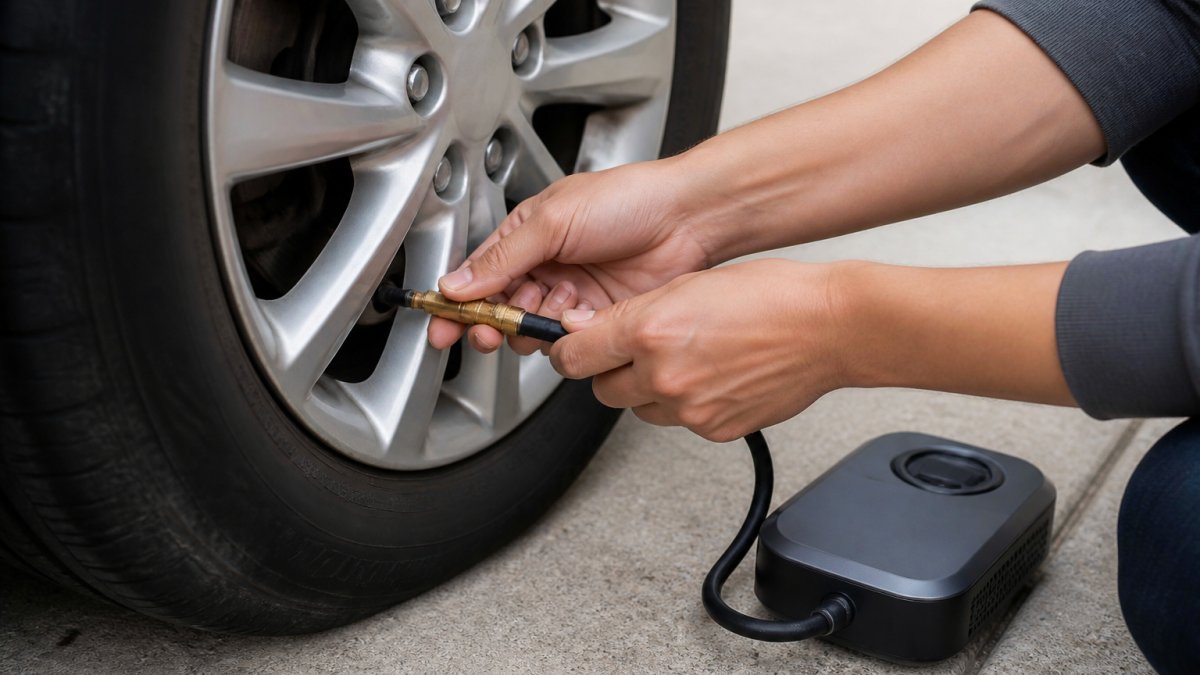
Remove the valve cap and attach the inflator's hose or nozzle firmly to the valve stem, a secure connection prevents air leaks.
Stop at the target pressure. Most modern inflators shut off automatically at a preset PSI; manual models require you to watch the gauge and release the power button yourself.
Let the tire rest a minute before driving.
Perform this process on all four tires every month, or whenever you notice uneven wear or reduced fuel efficiency. Seasonal changes matter too: pressure drops about 1 PSI for every 10-degree Fahrenheit drop, so winter drivers should check more frequently.
Portable Tire Inflator with Auto Shutoff: Why It Matters
Automatic shutoff is one of the most useful features on a modern compact tire inflator: set your target pressure, press the button, and it stops automatically when that pressure is reached.
This prevents over-inflation, which damages tires and shortens their lifespan, over-inflated tires wear faster in the center, bulge outward, and ride harsher.
Most auto shutoff inflators adjust the target pressure in 5 PSI increments; some allow 1 PSI steps. Precision matters less for occasional use, hitting your target within 2 PSI is perfectly acceptable for regular driving.
Manually operated inflators without auto shutoff are cheaper but require active monitoring, watching the gauge and releasing the power button at exactly the right moment.
Choosing the Right Compact Tire Inflator for Your Needs
Selecting the right portable tire inflator depends on your situation and how you plan to use it.
Ask yourself: Do you want cordless convenience or maximum speed? Will you store it in your vehicle or at home?
Occasional drivers who value simplicity should choose a cordless model with automatic shutoff.
Consider where you'll actually use the inflator. For routine maintenance at home, a 12V model works fine because you're near your vehicle.
Frequently Asked Questions
What is the best compact tire inflator for occasional use?
The best choice depends on your priorities. For convenience, cordless models offer portability and no setup time. For speed and reliability, 12V inflators plug into your vehicle's power outlet and deliver consistent pressure. Look for models with digital gauges, auto shutoff, and maximum pressure ratings of at least 100 PSI to handle most car and SUV tires.
How long does it take a portable tire inflator to fill a tire?
Inflation time varies by model and tire size. Most compact inflators fill a standard car tire from 20 PSI to 35 PSI in 3-8 minutes. 12V models are typically faster (3-5 minutes), while cordless battery-powered inflators take 5-10 minutes depending on battery capacity. Starting pressure matters: topping off a tire that's only 5 PSI low is much quicker than inflating a significantly underinflated tire.
Is a cordless or 12-volt tire inflator better for occasional drivers?
Cordless inflators win on convenience: they're always ready without needing your car running. However, 12V models are faster and never risk battery depletion during an emergency. For occasional drivers, cordless is ideal if you remember to charge it regularly. If you worry about battery readiness, a 12V model plugged into your vehicle's power outlet is more reliable. Consider keeping both if budget allows.
What features should I look for in a portable tire inflator?
Prioritize a digital pressure gauge for accuracy, auto shutoff to prevent overinflation, and a maximum pressure rating of 100+ PSI for versatility. Hose length (at least 3 feet) matters for reaching all tires easily. LED lights help during nighttime roadside emergencies. For occasional drivers, compact size and lightweight design reduce trunk clutter. Battery life (cordless models) or cord length (12V models) determines practical usability.
Choosing the right compact tire inflator means having one less thing to worry about on the road. The best inflator for you balances portability, speed, and reliability based on how you actually drive. At Blue Point, we stock a curated selection of portable tire inflators and other automotive essentials so you can find the right tool without endless searching. Browse our car care category, compare your options, and invest in the peace of mind that comes with being prepared.
